CRM &
Lead Generation
Pipeline Systems & Marketing Operations · intellimation.ai
Pipeline Systems & Marketing Operations · intellimation.ai
Years of enterprise relationships at intellimation.ai sat in personal networks, inboxes and spreadsheets rather than in a system. I took the leadership team's sales portfolio and migrated it into Zoho CRM: 341 opportunities and 238 named leads across 164 financial institutions: global banks, asset managers, hedge funds, custodians and exchanges.
Migration was only the first half. The second was making the data usable: a defined qualification funnel, consistent record types, segmentation by institution and role, and lead generation campaigns built on top of it using Waalaxy and LinkedIn Sales Navigator. The result was a single source of truth that the CEO, the commercial team and marketing could all work from, and that fed every event invitation, demo and follow-up sequence that came after it.
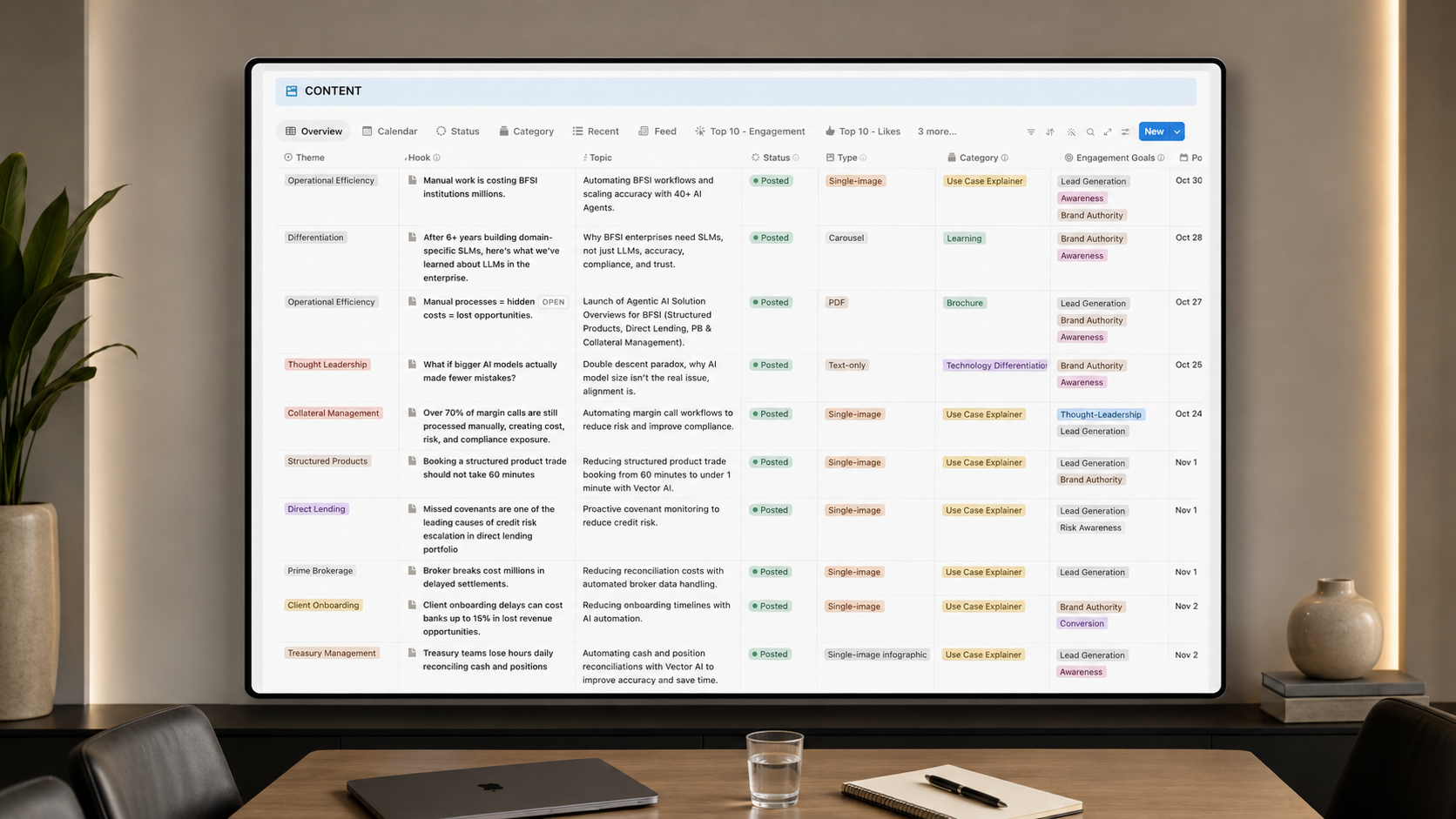
Some visuals are editorial recreations created for portfolio presentation. Original client materials have been anonymised or recreated where necessary due to NDA and confidentiality obligations. All project work, deliverables and outcomes reflect genuine professional experience.
Turning years of personal relationships into a shared commercial asset.
Before the migration, the commercial pipeline existed as a working spreadsheet owned by one person. It held real value, years of relationships across global banks and asset managers, but only one person could act on it, and nothing downstream could be built from it.
I rebuilt it as structured CRM data: every opportunity given a consistent record type (prospect, existing client, lead, partner or referral partner), an owner, a source, a role and a qualification stage. Contacts were deduplicated, roles verified and gaps flagged rather than quietly filled in. That last part mattered more than it sounds. Roughly a fifth of leads had no confirmed job title, so I marked them for verification instead of guessing, which kept the database honest and the outreach accurate.
A six-stage qualification funnel, so every record had a defined next step rather than a status someone had to interpret.
Alongside the funnel, each opportunity carried the fields a commercial conversation actually needs: expected contract start date, a RAG confidence rating, what we were selling, why we believed it would close, the overall sales cycle, and the specific next step to unblock it. Deals were graded cold, warm or hot so the team could prioritise by temperature rather than by whoever shouted loudest.
Tagging every record with its source turned the CRM into an attribution tool, not just a contact list.
I tracked 29 distinct lead sources across the portfolio. The clearest finding was that executive events were the single largest source of qualified opportunity: the Collateral Management Optimisation Summit alone accounted for 81 opportunities, more than any individual, referral partner or outbound channel.
That is the kind of insight a CRM only gives you if someone maintains it properly. It also closed the loop between two parts of my role: the events I helped deliver were measurably feeding the pipeline I was maintaining, and I could show that with data rather than assert it.
Targeted LinkedIn outreach built on top of the CRM, segmented by role, product line and geography.
Rather than one generic outbound list, I built four separate campaigns totalling 544 prospects, each segmented against a specific product line and buyer:
Segmenting by role and geography meant the message could change with the audience. A Head of Operations and a Managing Director at the same firm care about different things, and a prospect you can meet in person next month deserves a different sequence to one you cannot.
The CRM stopped being an admin task and became the layer everything else ran on.
Once the data was structured and segmented, the same system supplied the invitation lists for executive events, the follow-up sequences after demos and proofs of concept, the audience segments for email campaigns, and the account context the commercial team needed before a call. The executive events programme and the outreach behind it drew directly from these segments.
The measurable part was reach and readiness rather than a single headline number: hundreds of enterprise relationships that had been effectively inaccessible became searchable, segmentable and actionable by the whole team.
What worked, and what I would change.
I am most proud that the system outlived the migration. Structuring the data so that lead source, stage and next step were mandatory rather than optional is what made attribution possible later, and that was a design decision made at the start, not a fix applied afterwards.
If I did it again, I would define the campaign measurement framework at the same time as the CRM structure. I built the pipeline architecture carefully, but outreach performance data was captured less consistently than the pipeline data was, which makes some of that work harder to evidence now than it should be.